
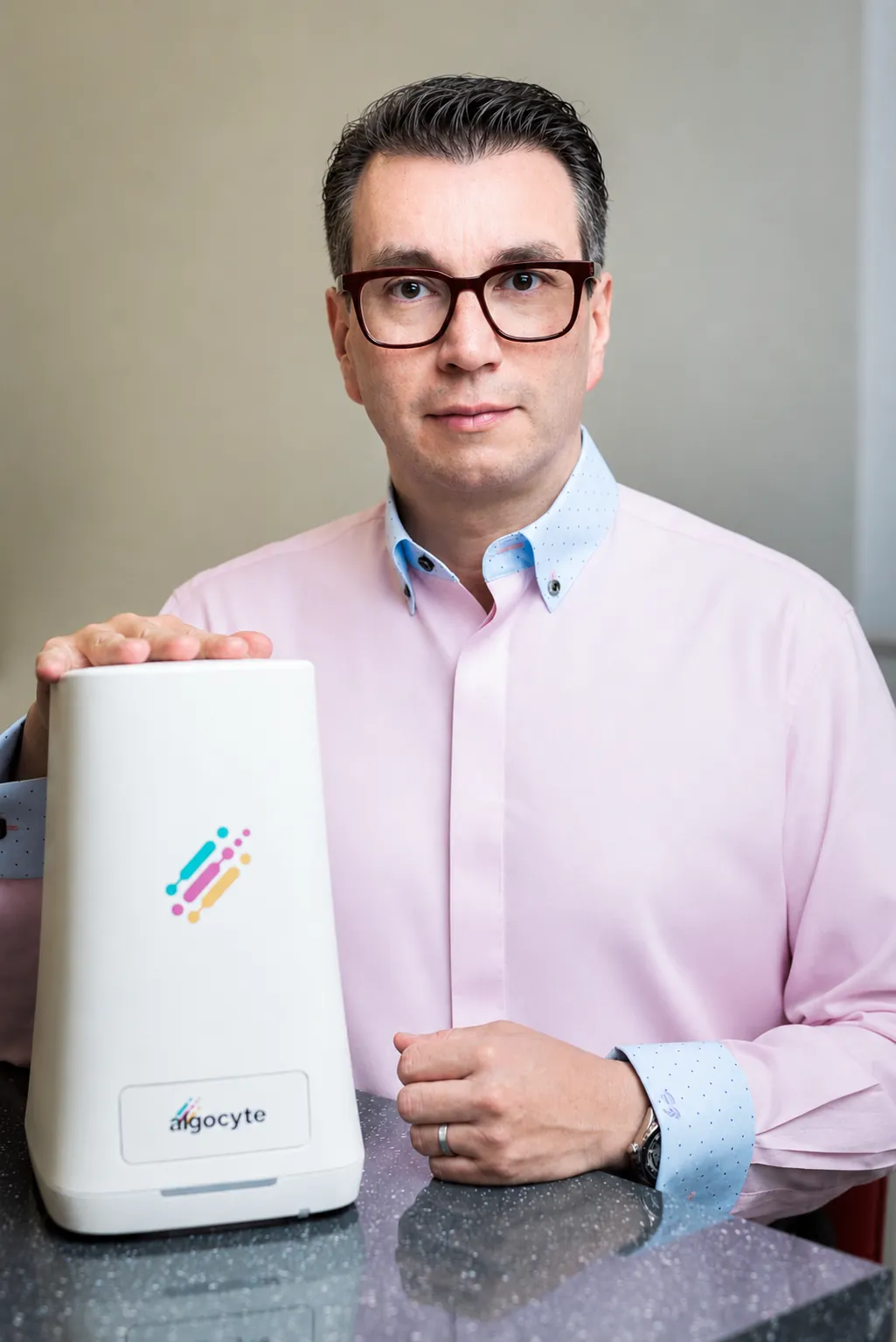
Dr. Hector Zenil FRSM
Ph.D. in Computer Science (Lille), Ph.D. in Logic and Epistemology (Paris, Sorbonne / ENS). Associate Professor in Healthcare Engineering, School of Biomedical Engineering and Imaging Sciences, Departments of Biomedical Computing and Digital Twins, Faculty of Medicine and Life Sciences and King's Institute of AI, King's College London. Research Associate Member, Cancer Research Group, The Francis Crick Institute.
hectorzenil.comOriginally trained in pure mathematics at the National University of Mexico (UNAM), he completed postgraduate studies and two PhDs in nanotechnology, computer science, logic and epistemology at Oxford in the UK, the Sorbonne/École Normale Supérieure in Paris and the University of Lille 1 also in France.
With PhD thesis advisors such as Prof Gregory Chaitin, one of the founders of modern computer science and complexity science; and Prof Barry Cooper, a student of the only PhD student of Alan Turing, Dr Zenil's research expanded into systems biology and computational medicine, beginning at the Behavioural Evolutionary Theory Lab at the University of Sheffield in the UK before joining the Unit of Computational Medicine at the Karolinska Institute as an Assistant Professor.
His work builds on Algorithmic Probability, a formal foundation underpinning modern artificial intelligence founded by Chaitin who described Dr. Zenil as a "new kind of practical theoretician" during his PhD defence thesis, also publicly commending his work.
For more than a decade, he was affiliated with Wolfram Research, serving on the faculty of the Wolfram Science Summer School in Boston and contributing in the original core team of Wolfram|Alpha directly under Dr Stephen Wolfram's direction at his Think Tank office in Boston, the AI computational knowledge engine that has powered or supported factual answering behind Siri, Alexa and ChatGPT through an official plugin released by OpenAI. Wolfram has continued to reference Dr Zenil's work in his own writings (e.g. P vs. NP and the Difficulty of Computation).
Today, Dr. Zenil is Associate Professor in Healthcare Engineering at King's College London with over 130 peer-reviewed publications in outlets such as Nature and the Royal Society journals, multiple patents granted in the medical device space, contributing to the development of methods in optimal inference theory and their applications to scientific discovery, computational medicine, and systems biology, in particular to blood, cellular, and molecular biology.
His scientific trajectory is further reflected in his association with leading figures in science beyond Chaitin and Wolfram. For example, Sir Roger Penrose, Nobel Laureate in Physics (2020), wrote a foreword to his work, commenting on his contributions.
By synthesising Chaitin's work on information theory and algorithmic complexity with Wolfram's computational universe approach, Dr Zenil has moved these elite theories out of the intellectual "ivory tower" into the clinic.
As the architect of Algocyte, he has translated the abstract "It from Bit" doctrine into a cutting-edge precision medicine solution. By replacing the "black box" approach of traditional AI with physics-informed algorithmic causal discovery.
Get in touch
For research collaborations, partnership enquiries and speaking requests, email changetheworld@algocyte.ai. You can also find more of Dr. Zenil's research, publications and talks at hectorzenil.com.
Bring regular precision and predictive monitoring to users and patients.
See Algocyte in action.